Medical Aid In Dying
Act 39: Patient Choice and Control at the End of Life
In May of 2013, Vermont became the fourth state to legalize Medical Aid in Dying (MAID). Vermont’s law (Act 39) permits a physician to prescribe to a terminally ill, capable, adult patient medication to be self-administered for the purpose of hastening their own death. In 2023, Vermont became the first state in the nation to pass legislation that permits MAID services to be provided to qualifying patients regardless of the state in which they legally reside.
While the Vermont Ethics Network (VEN) recognizes that Vermonters hold a diversity of views in regard to MAID, the practice is a legal end-of-life care option in this state. Act 39 outlines the process a physician must follow to be immune from any civil, criminal or professional disciplinary action for participation in medical aid in dying. There are currently 11 states in the United States where MAID is permitted.
Participation in Act 39 is voluntary—for patients and health care providers. Patients seeking this end-of-life option can change their mind at any time. While many Vermont physicians, facilities and hospice organizations now have experience with Act 39, their participation is also voluntary. There is no public list of participating prescribers.
Qualifying Criteria for Medical Aid in Dying under Vermont’s Act 39
A patient must:
- Be at least 18 year of age or older
- Have a terminal illness with a prognosis of six months or less to live
- Be capable of making their own health care decisions
- Be able to make an informed and voluntary request to their physician
- Be able to self-administer the medication
Process for Medical Aid in Dying under Vermont’s Act 39
The patient must:
- Make two oral requests not less than 15 days apart to the physician who will be writing the prescription. Oral requests may be made in the physician’s physical presence or by telemedicine if the physician determines use of telemedicine is clinically appropriate.
- Make a written request. The written request must be signed in the presence of two (2) witnesses who are at least 18 years of age and who sign and affirm that the patient appeared to understand the nature of the document and to be free from duress or undue influence at the time the request was signed.
- Have a second physician confirm that the patient meets the required qualifying criteria.
The doctor will write the prescription, provide instructions on where the prescription will be filled and how to take the medication. Even after a prescription is filled, the patient can decide whether or not they wish to take it. They can change their mind at any time.
Witnesses to the patient’s written request cannot be:
- the patient’s physician;
- a patient’s relative by blood, civil marriage, civil union or adoption;
- a person who knows that s/he would be entitled, upon the patient’s death, to any portion of the estate or assets of the patient under any will or trust, by operation of law, or by contract; or
- an owner, operator, or employee of a health care facility, nursing home, or residential care facility where the patient is receiving medical treatment or is a resident.
Patient Choices Vermont (PCV), a non-profit organization focused on Medical Aid in Dying education, has many resources that can help:
- The PCV brochure page for a simple explanation.
- The PCV page on guidance for talking to your doctor.
- Clinician’s Guide to MAID under Vermont’s Act 39: https://www.patientchoices.org/clinicians-guide.html
- Guidelines and Checklist for Non Residents and their Doctors: https://www.patientchoices.org/non-residents.html
No. In May of 2023, Vermont became the first state in the nation to pass legislation that permits medical-aid-in-dying services to be provided to qualifying patients regardless of the state in which they legally reside. Even though Vermont’s residency requirement has been removed, this does not guarantee access to Medical Aid in Dying for persons coming from another state. Patient Choices Vermont provides helpful guidelines and a checklist for those seeking additional information.
Participation is voluntary. Per section 5285 of 18 VSA Chapter 113, a physician, nurse, pharmacist, or other person shall not be under any duty, by law or contract, to participate in the provision of a lethal dose of medication to a patient. Further, a health care facility or health care provider shall not subject a physician, nurse, pharmacist, or other person to discipline, suspension loss of license, loss of privileges or other penalty for participation or refusal to participate in Vermont’s Patient Choice at the End-of-Life law.
A health care facility may prohibit a physician from writing a prescription for a lethal dose of medication when all 3 of the following conditions exist:
- The patient is a resident in the facility;
- The patient intends to use the medication on that facility’s premises; and
- The facility has notified the physician in writing of its policy in regard to prescribing medications pursuant to the new law.
Prescribing Physician Process: A physician must:
- Determine that the patient is suffering from a terminal condition based on the review of the patient’s relevant medical records and a physician’s physical examination of the patient.
- Determine that the patient is capable.
- Determine that the patient is making an informed decision.
- Determine that the patient is making a voluntary request for medication to hasten their death.
- Determine that the patient is able to self-administer the medication requested to hasten death.
- Inform the patient in person or by telemedicine, both verbally and in writing of the following:
- The medical diagnosis.
- The prognosis, including an acknowledgment that this is a prediction of life expectancy and an estimate based on the physician’s best medical judgment, is not a guarantee of the actual time remaining in the patient’s life and that the patient could live longer than the time predicted.
- The range of treatment options appropriate for the patient’s diagnosis.
If the patient is not enrolled in hospice care, all feasible end-of-life services, including palliative care, comfort care, hospice care and pain control. - The range of possible results, including potential risks associated with taking the prescribed medication.
- The probable result of taking the prescribed medication.
- Refer the patient to a second physician for medical confirmation of the diagnosis, prognosis, and a determination that the patient is capable, is acting voluntarily, and is making an informed decision.
- Either verify that the patient did not have impaired judgment or refer the patient for an evaluation by a psychiatrist, psychologist, or clinical social worker licensed in Vermont for confirmation that the patient is capable and does not have impaired judgment.
- Consult with the patient’s primary care physician, with the patient’s consent, if applicable.
- Inform the patient of their right to rescind their request at the time that the second oral request is made (which can be no fewer than 15 days after the first oral request).
- Ensure that all the required steps were carried out in accordance with the law and confirm, immediately prior to writing the prescription, that the patient was making an informed decision.
- Write the prescription after the last of the following events:
- The patient’s written request for medication to hasten death,
- The patient’s second oral request (which can be no fewer than 15 days after the first oral request); and
- The physician offering the patient an opportunity to rescind the request.
- Dispense the medication directly (if they are licensed to dispense medication in Vermont); or contact a pharmacist (with the patient’s consent) and inform the pharmacist of the prescription, and deliver the written prescription personally, by mail or by fax to the pharmacist.
- Promptly file a report, after writing the prescription, with the Department of Health documenting completion of all of the requirements under this statute.
Documentation: The physician must record and file the following in the patient’s medical record:
- The date, time and wording of all oral requests by the patient for medication to hasten death.
- All written requests by the patient for medication to hasten death.
- The physician’s diagnosis, prognosis, and the basis for the determination that the patient was capable, and was acting voluntarily and had made an informed decision.
- The second physician’s diagnosis, prognosis and verification that the patient was capable, and was acting voluntarily and had made an informed decision.
- The physician’s attestation that the patient was enrolled in hospice care at the time of the oral and written requests for medication, or that the physician informed the patient of all feasible end-of-life care services.
- The physician’s verification that the patient either did not have impaired judgment or that the physician referred the patient for an evaluation and the person conducting the evaluation determined that the patient did not have impaired judgment.
- A report of the outcome and determinations made during any evaluation which the patient may have received.
- The date, time and wording of the physician’s offer to the patient to rescind their request at the time of the patient’s second oral request.
- A note by the physician indicating that all requirements under the statute were satisfied, describing the steps taken to carry out the request and including a notation of the medication prescribed.
Reporting: After writing the prescription, promptly file a report with the Department of Health documenting completion of all of the requirements under this statute.
Other Statutory Obligations: Physicians have an obligation to inform patients of all available options related to terminal care pursuant to 18 V.S.A. § 1871. Patient Choice at the End of Life as outlined in 18 V.S.A. Chapter 113 is now an available option related to terminal care. In addition, pursuant to 12 V.S.A. §1909(d), a patient is entitled to a reasonable answer to any specific question about foreseeable risks and benefits of treatment.
Immunity: Physicians shall not be subjected to any civil or criminal liability or professional disciplinary action if the physician prescribes to a patient with a terminal condition medication to be self-administered for the purpose of hastening the patient’s death and affirms by documenting in the patient’s medical record that the necessary steps were followed. (18 VSA Chapter 113 §5283 (a))
Limitations on Actions: No physician, nurse, pharmacist, or other person licensed, certified, or otherwise authorized by law to deliver health care services in this State shall be subject to civil or criminal liability or professional disciplinary action for acting in good faith compliance with the provisions of this chapter.
Participation in Act 39 is voluntary. Per § 5285 of 18 VSA Chapter 113, a physician, nurse, pharmacist, or other person shall not be under any duty, by law or contract, to participate in the provision of a lethal dose of medication to a patient. Further, a health care facility or health care provider may not penalize a physician, nurse, pharmacist, or other person based on their participation or refusal to participate in the law.
Act 39 does not alter the rights and duties existing under Vermont’s Patient’s Bill of Rights, 18 V.S.A. § 1871, or under 12 V.S.A. § 1909 regarding informed consent.
Legal References
18 V.S.A. § 5282 Right to Information:
“The rights of a patient under Section 1871 of this title to be informed of all available options related to terminal care and under 12 V.S.A. § 1909(d) to receive answers to any specific question about the foreseeable risks and benefits of medication without the physician’s withholding any requested information exist regardless of the purpose of the inquiry or the nature of the information. A physician who engages in discussions with a patient related to such risks and benefits in the circumstances described in this chapter shall not be construed to be assisting in or contributing to a patient’s independent decision to self-administer a lethal dose of medication….”
18 V.S.A. § 1871. Patient’s bill of rights for palliative care and pain management:
- A patient has the right to be informed of all evidence-based options for care and treatment, including palliative care, in order to make a fully informed patient choice.
- A patient with a terminal illness has the right to be informed by a clinician of all available options related to terminal care; to be able to request any, all, or none of these options; and to expect and receive supportive care for the specific option or options available.
- A patient suffering from pain has the right to request or reject the use of any or all treatments in order to relieve his or her pain.
12 V.S.A. § 1909. Limitation of medical malpractice action based on lack of informed consent:
- A patient shall be entitled to a reasonable answer to any specific question about foreseeable risks and benefits, and a medical practitioner shall not withhold any requested information.
Participation in Act 39 is voluntary. Per §5285 of 18 VSA Chapter 113, a health care facility shall not subject a physician, nurse, pharmacist, or other person to discipline, suspension, loss of license, loss of privileges or other penalty for participating in or refusing to participate in Vermont’s Patient Choice at the End-of-Life law.
Definition: Health care facility is defined as all persons or institutions, including mobile facilities, whether public or private, proprietary or not for profit, which offer diagnosis, treatment, inpatient, or ambulatory care to two or more unrelated persons, and the buildings in which those services are offered. The term shall not apply to any institution operated by religious groups relying solely on spiritual means through prayer for healing, but shall include but is not limited to:
- hospitals, including general hospitals, mental hospitals, chronic disease facilities, birthing centers, maternity hospitals, and psychiatric facilities including any hospital conducted, maintained, or operated by the state of Vermont, or its subdivisions, or a duly authorized agency thereof;
- nursing homes, health maintenance organizations, home health agencies, outpatient diagnostic or therapy programs, kidney disease treatment centers, mental health agencies or centers, diagnostic imaging facilities, independent diagnostic laboratories, cardiac catheterization laboratories, radiation therapy facilities, or any inpatient or ambulatory surgical, diagnostic, or treatment center.
Health Care Facility Exemption (§5286): Under the new law, a health care facility may prohibit a physician from writing a prescription for a lethal dose of medication when all 3 of the following conditions exist:
- The patient is a resident in the facility;
- The patient intends to use the medication on that facility’s premises; and
- The facility has notified the physician in writing of its policy in regard to prescribing medications pursuant to the new law.
See the Vermont Department of Health’s FAQ list pertaining to Act 39, or visit Patient Choices Vermont for more frequently asked questions.
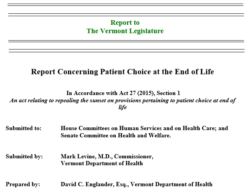 2018 Report Concerning Patient Choice at the End of Life
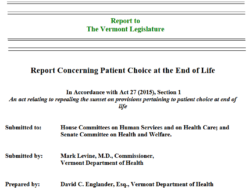 2020 Report Concerning Patient Choice at the End of Life
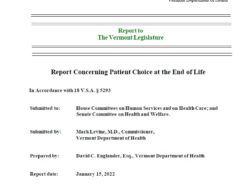 2022 Report Concerning Patient Choice at the End of Life
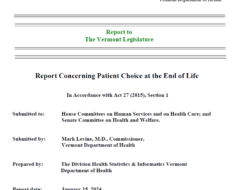 2024 Report Concerning Patient Choice of the End of Life
